- SPECIALIST ORTHOPAEDIC SURGEON | MELBOURNE, VIC | ALBURY, NSW | MORNINGTON, VIC |
- 03 9421 6133
- Melbourne & Mornington VIC |
- Albury, NSW
The posterolateral corner (PLC) of the knee is a complex network of ligaments, tendons, and joint capsule structures that work together to stabilise the outer (lateral) side of your knee. One of these key stabilisers is the posterolateral femoral ligament (PFL), which plays an important role in resisting external rotation, varus (inward angling) forces, and preventing hyperextension.
Injuries to the PLC, often due to trauma, sports injury, or dislocation, can lead to significant instability, difficulty walking, and an increased risk of further joint damage if left untreated. When non-operative treatments fail or when there is a complete tear of key PLC structures, surgical reconstruction may be recommended.
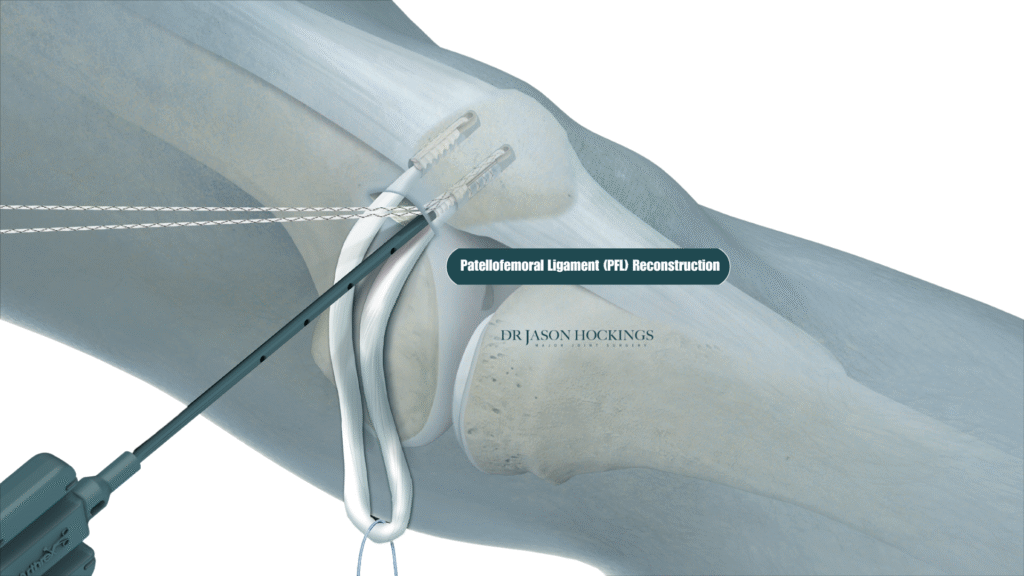
PFL reconstruction is a procedure performed to restore stability to the lateral side of the knee by reconstructing the damaged ligament using a tendon graft. In many cases, PFL reconstruction is part of a broader posterolateral corner reconstruction, which may also involve repairing or reconstructing the lateral collateral ligament (LCL) and popliteus tendon.
Dr Jason Hockings performs this procedure arthroscopically or through a small open incision, using modern anatomical reconstruction techniques designed to restore your knee’s natural biomechanics, improve function, and prevent long-term degeneration.
If other ligaments are also torn, such as in multi-ligament knee injuries, Dr Hockings may perform a staged or combined procedure to address all damaged structures. In some cases, repair of torn tissue may be possible instead of full reconstruction.
The procedure usually takes around 90 minutes to 2 hours, depending on the complexity, and is performed as an inpatient surgery with an overnight hospital stay.
If you’re experiencing ongoing pain, stiffness, or reduced movement that is affecting your daily activities or quality of life, a thorough orthopaedic assessment can help determine the cause and guide the most appropriate treatment options for your situation.